
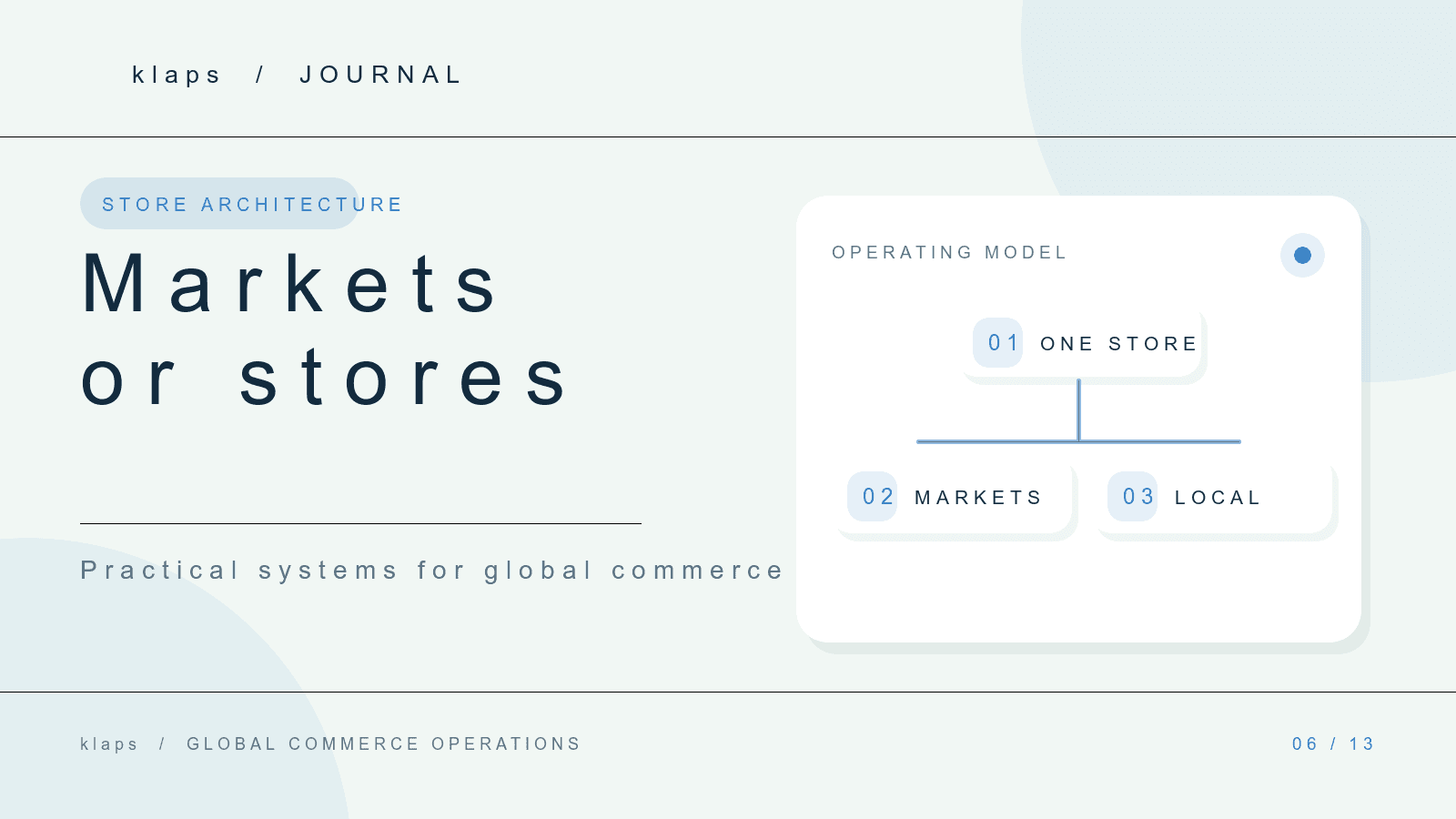
The question is not whether Shopify Markets can support international selling. It can manage market-specific experiences including currency, language, pricing, product availability, theme content, domains, and taxes.
The harder question is whether one operating system should control every market.
One store with Markets reduces duplication and keeps shared data together. Separate stores create stronger boundaries for teams, catalogs, compliance, and integrations. Either structure can work. The wrong structure is the one that ignores how the brand actually makes decisions.
Start With The Default: One Store
Use one store unless a real market constraint requires separation.
One store is usually the cleaner starting point when markets share:
- The same core catalog and product identifiers
- Similar merchandising and launch calendars
- One central ecommerce team
- Shared inventory and fulfillment logic
- The same app and integration stack
- A consolidated customer and analytics model
Shopify Markets lets operators define audiences and tailor experiences with market customizations. Domains and languages can be assigned by market, and Shopify can generate hreflang tags based on configured market and language URLs.
The benefit is not only lower platform duplication. It is one place to maintain products, theme components, apps, tracking, and operational knowledge.
When Separate Stores Become Rational
Separate stores make sense when the business itself is separated.
Consider separate stores when several of these conditions are true:
- The market has a substantially different catalog or product compliance model.
- A local team controls merchandising, pricing, content, and promotion calendars.
- Inventory, fulfillment, returns, or tax operations use different systems.
- Legal entities, payment accounts, or data policies require stronger separation.
- The storefront requires materially different theme behavior or app dependencies.
- Reporting and P&L ownership are independent.
- The cost of central coordination is already higher than the cost of duplication.
A separate store should solve an operating constraint. “The Japan site should feel more local” is not enough by itself. Markets and theme content customizations may address that within one store.
Compare The Seven Decision Areas
1. Catalog
If most products are shared and only availability changes, one store is often easier. If product definitions, variants, bundles, or regulatory data diverge, separate stores may reduce exceptions.
Ask:
- Are SKUs globally consistent?
- Can one product record support every market’s required information?
- Who approves assortment changes?
- Do local bundles or subscriptions change inventory logic?
2. Pricing And Promotions
Markets can support pricing customizations, but operating governance still matters.
One store fits when a central team controls price architecture and local adjustments follow a common rule. Separate stores fit better when local teams independently set prices, promotions, discounts, and margin targets on different calendars.
Fixed-amount discounts and gift cards can interact with currency conversion, so test actual checkout behavior for each market rather than assuming a displayed value is the final commercial rule.
3. Domain, Language, And SEO
Shopify supports market-specific subfolders, subdomains, and separate domains, subject to configuration and domain requirements. The domain choice should follow the SEO and brand strategy, not determine the store count on its own.
One store can still use localized URLs. Shopify states that properly configured market domains and languages support international SEO and generate hreflang tags.
Separate stores create separate sitemap, redirect, content, and monitoring responsibilities. That can be useful when strategies are independent, but it also increases governance work.
4. Payments, Duties, And Tax
Check payment eligibility, legal entities, settlement, taxes, duties, and customer-facing shipping terms in each destination.
Shopify’s international documentation notes that multi-currency behavior can depend on Shopify Payments and that duties and import-tax rules vary by destination and can change. A market that requires a distinct payment or legal setup may justify separation, but this is a compliance and finance decision, not only a storefront decision.
Do not encode current duty thresholds into a long-lived architecture document without an owner and review date.
5. Inventory And Fulfillment
One store works well when inventory is visible through a shared source of truth and market routing can be expressed with locations, availability, and shipping rules.
Separate stores may fit when:
- Markets use unrelated warehouses or ERP instances
- Allocation is contractually separated
- Orders require different fraud, export, or compliance workflows
- Returns and customer support are operated independently
The important question is how overselling, substitutions, cancellations, and stock transfers are resolved.
6. Apps, Integrations, And Data
Every additional store can multiply app subscriptions, configuration, permissions, webhooks, feeds, consent settings, and QA.
Create an integration matrix:
Scroll horizontally to read the table.
| System | Shared or local? | Data owner | Store boundary impact |
|---|---|---|---|
| ERP / OMS | |||
| 3PL / WMS | |||
| CRM / email | |||
| Reviews / loyalty | |||
| Analytics / pixels | |||
| Product feeds |
If the systems are shared, multiple stores need reliable consolidation. If systems are local, forcing everything into one store may create a different set of exceptions.
7. Team And Governance
This is often the deciding factor.
One store needs clear rules for who can change global products, theme components, markets, apps, and tracking. Separate stores need standards for what must remain consistent across stores.
Ask:
- Who owns the global platform?
- Which decisions can local teams make without approval?
- How are changes tested before reaching every market?
- Who reconciles reporting across stores?
- Which customer data is shared?
Architecture without governance becomes accidental architecture.
A Practical Decision Matrix
Score each statement from 0 to 2: 0 means shared, 1 means partially different, and 2 means independent.
Scroll horizontally to read the table.
| Area | 0: Shared | 1: Mixed | 2: Independent |
|---|---|---|---|
| Catalog | Same products and rules | Some local exceptions | Different definitions or compliance |
| Team | Central team | Shared ownership | Local autonomous team |
| Systems | Shared stack | Some local tools | Separate ERP/3PL/CRM |
| Commercial model | Shared pricing logic | Local adjustments | Independent P&L and calendar |
| Legal/compliance | Same entity and policies | Some constraints | Distinct entity or data boundary |
A low score supports one store. A high score supports deeper separation analysis. The middle is not an automatic hybrid. It is a prompt to identify which differences are durable and which are temporary launch accommodations.
Avoid Three Common Architecture Mistakes
Creating Stores For Every Country
Country count does not equal operating-model count. Several countries may share one market model, while one country may need distinct B2B and DTC experiences.
Forcing Every Exception Into One Store
Centralization is not free when every release requires fragile conditions and local workarounds.
Splitting Before The First Market Is Proven
Do not build a multi-store organization for hypothetical scale. Start with the smallest structure that supports the first market and leaves a documented separation path.
Make The Decision Reversible
Document:
- Why the current structure was chosen
- Which assumptions support it
- Which signals would trigger a split or consolidation
- How product IDs, customer data, URLs, and analytics would move
- Who reviews the decision and when
The best architecture does not predict every future market. It makes the next market operable without hiding the cost of change.
Official Sources
- Shopify Help Center, Markets: https://help.shopify.com/en/manual/markets
- Shopify Help Center, International domains: https://help.shopify.com/en/manual/international/managing-international-domains
- Shopify Help Center, Domains and languages: https://help.shopify.com/en/manual/markets/customizations/domains-and-languages
- Shopify Help Center, Localization and translation: https://help.shopify.com/en/manual/international/localization-and-translation
- Shopify Help Center, Duties and import taxes: https://help.shopify.com/en/manual/international/duties-and-import-taxes